
Plan: The Most Interesting Thing That Came Out of Microsoft Fabric Community Conference in April 2026
by Ginger Grant | April 24, 2026
Microsoft has made FABCON, which is now combined with SQLCON to be the second-largest conference. They rolled out a number of new product announcements and provided a lot of content to ensure the crowd of 8,000 would not be disappointed. Naturally, AI features were among the prominent new features, but Microsoft also included a number of different management features such as Database Hub, and additional uses of AI, including improvements in Fabric IQ to provide a better ability to ask questions of your data. Of all the new features and upgrades which were announced, one stood out as providing a clear benefit to a problem businesses agonize over: budgeting and planning. The new Fabric feature is called Plan. Plan is a part of Fabric, which means anyone with a Microsoft Fabric product license can start using it.
For those who have been following Microsoft’s partnership notifications, Plan wasn’t a a complete surprise, but many haven’t. Plan’s polished debut and feature review at the keynote at FABCON was very impressive. In December 2024 Microsoft announced they were going to do a deep partnership with Lumel, which had an Enterprise Performance Management (EPM) tool for planning which they were going to be tightly integrating with Fabric and Power BI. Lumel announced the tool was ready in September 2025 as an ISV workload. The Lumel EPM suite had its own pricing model and was designed as a low code planning workflow application. On March 17, 2026 at FABCON, Microsoft demonstrated the new feature Plan as part of the keynote, demonstrating how you could use it for low code budgeting and project planning.
Of all of the products and features discussed at the conference, this one was the most impressive because it offers a real solution to assist people who are trying to create a strategy to figure out how the money should be spent or how hours in a project should be allocated. It uses machine learning algorithms to predict the future based on provided goals. It provides the ability to perform a what if analysis and see for example how a change in one category impacts another. Once you are happy with the plan, the data is saved to a database.
To get started, your data can come from a semantic model or an Excel spreadsheet, the default location for most budgets today. Using Semantic models allows you to use any of the dimensions to slice and dice the data. You can change any value in the budget and the changes propagate to the appropriate levels, which you can see in this image.
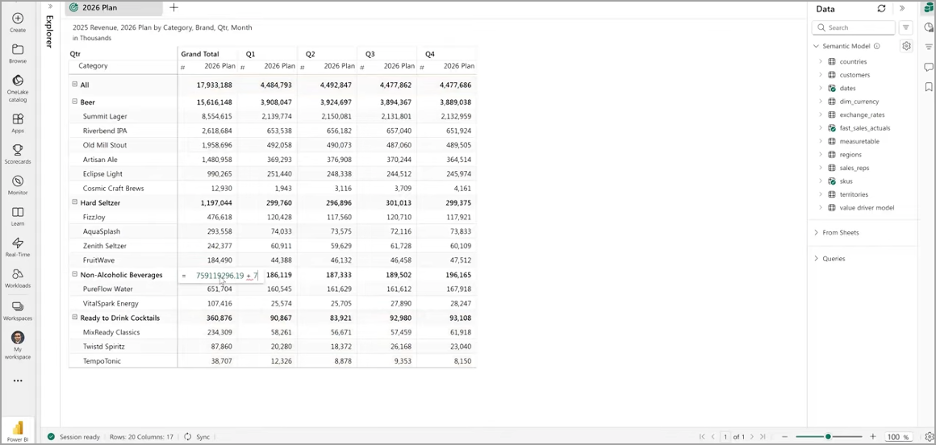
Want to add new category? No problem, you can just pull one from your Power BI semantic model. Plan will also sanity check your projected values to determine if they fall in the realm of numbers that are possible based upon previous data values and shows the projected values for related categories. If you want to use prediction algorithms for your budgeting, you can hindcast the algorithms (test them against known historical data) to ensure the values generated are accurate by validating them against previous years.
As the product matures, Plan will be managed by Microsoft as part of the Fabric tenant implementation, and Lumel will continue to offer Plan as a separate product. It will be interesting to see how this diverges over time. This feature enables AI-grounded budget planning built on your own data, significantly improving a process that has long frustrated organizations. For many teams, it may be reason enough to adopt Microsoft Fabric.