

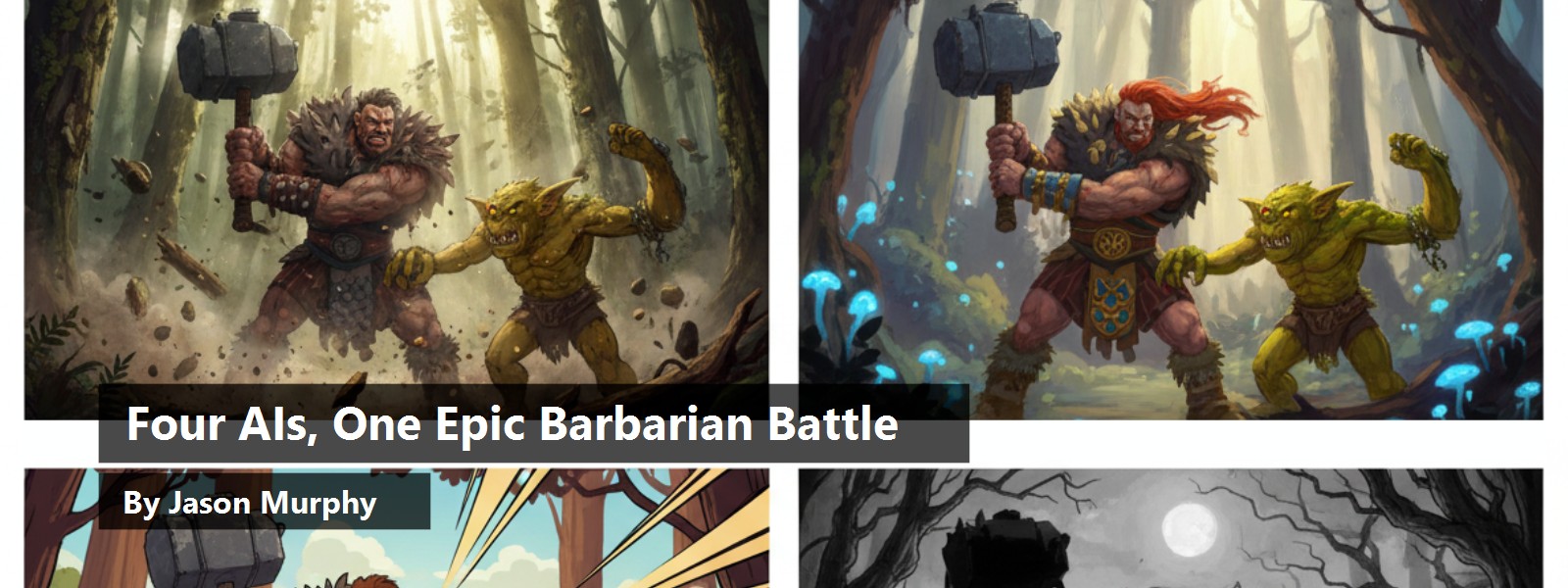
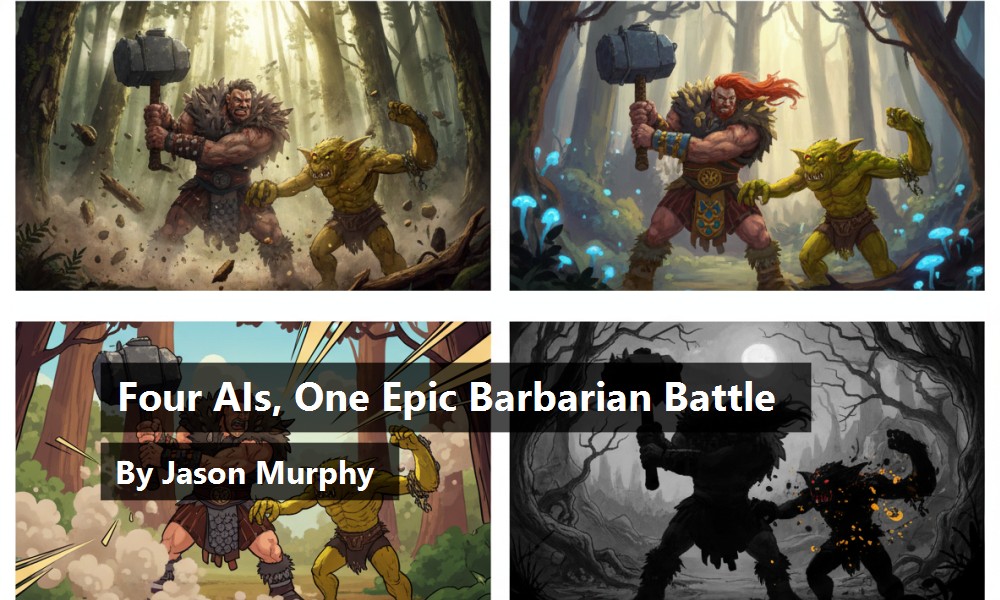

Before setting off on any creative quest, you must choose the right weapon. A warhammer can deliver massive impact—reality-bending moments that shock and awe the enemy with sheer might. The reliable and versatile short sword democratizes combat, opening the battlefield to warriors both veteran and new. And the exotic wizard's staff? It performs feats no conventional tool can match, reserved for creators daring enough to master its strange design.
By late 2025, the arsenal of weapons available at a creator's disposal had become mind-boggling. What do you choose? How will you enter combat? What weapons will guarantee victory? The AI video generation race continued to evolve from experimental novelty into legitimate production infrastructure, so these aren't just gimmicks. These video models were formidable (and a little dangerous). As of this writing, four video-generating AI models are considered the vanguards: OpenAI's Sora 2, Google DeepMind's Veo 3, Kuaishou's Kling 2.5, and Alibaba's Wan 2.5. Each reflects a distinct stance on what AI video should be. Sora 2 pushes cinematic realism with physically plausible motion and built-in and synced audio. Veo 3.1 prioritizes professional-grade control—native audio, stronger narrative control, and flexible delivery formats. Kling 2.5 competes on efficiency, pairing capable generation with notably lower per-video pricing. Wan 2.5 natively fuses sound and image, generating synchronized audio-visual clips in a single step.
The AI video generation race is about far more than tech specs and benchmarks, however. It's about core design principles that shape every aspect of how these systems operate. Is the tool optimized for single-shot perfection or sustained narrative cohesion? Is audio generated within the tool or added as a supplement? Is the system contained within strict guardrails, or is the governance user driven? Each choice isn't just design –this is a statement about the role of AI in human creativity.
The Contenders: Four Models, Four Philosophies
Every AI video model is more than just an assortment of different weights or parameters. The race This isn't just tech companies competing to solve the problem of generative AI. It's planting a flag to determine what aspects of AI video generation are most important. Because these video models are the first of their kind, their success will shape the entire field moving forward. The victory of VHS over Betamax defined an entire industry. The most popular model of this nascent tech could also have similar primacy over all AI video generation.
Sora 2: Physics Perfection?
When OpenAI unveiled Sora 2, many called it AI video's GPT-3.5 moment*. It was meant to be an inflection point, the moment when AI-generated video proved itself as a practical creative tool. To quote the hitman and junkie Vincent Vega, “That's a bold statement.” That aggressive branding may not be all hype, however. Sora 2 demonstrated a notable leap forward from the debut Sora model released in 2024. OpenAI presents Sora 2 along with their suite of Large Language Models, as seen in Figure 1.

At the core of Sora's approach is its focus on physical realism. You may remember how earlier video models garnered much deserved ridicule by warping reality to complete a prompt. If the model couldn't reconcile movement trajectories required by the prompt, it would morph objects out of shape or teleport them into position. Sora 2 strives to adhere closer to the laws of physics. If the prompt requires a plane touching down, the wheels won't immediately connect and “glue” to the runway. Now the wheels bounce with weight and inertia before settling down onto terra firma. (Or so they say. More on that later.)
A new feature of note illustrates Open AI's approach to gaining widespread acceptance of the tool. Cameo allows users to insert their likeness into generated clips. This launched alongside a dedicated iOS app with an Android app launching shortly after. The app is essentially TikTok, a social platform focused on AI video. It's the company's most obvious and direct play for mass consumer adoption. Users can browse, collaborate, and remix AI creations. As of this writing, the applications are only available in the United States and Canada, although future expansion is in the works. Basic access is free for casual creators.
Despite these significant advancements in realism and physical accuracy, Sora 2 is not without its flaws. Text rendering is unreliable, with words sometimes appearing as complete gibberish. Fine object detail is still plagued with minor inconsistencies. Other issues persist with temporal continuity and complex multi-action sequences. Water and reflective surfaces are often inconsistent, and character motion can be uncanny, with that weird, floaty feeling that immediately flags a video as AI.
Veo 3: Cinematic Control
Google DeepMind entered the text-to-video arms race with Veo 3, which wowed users with its native audio generation. Where OpenAI focuses on its physics-accurate takes, Google's approach emphasized pro-grade control with dynamic compositional range. Veo's opening page can be seen in Figure 2.

The publicly documented specifications for Veo 3 cite 720p-1080p resolution at 24-fps, but unlike Sora, single-clip generation is limited to eight seconds. With extension tools, creators can build sequences up to 60–148 seconds. Previously, Veo 2 supported 4K resolution, but this has yet to be confirmed for version 3.
Veo 3's audio generation is impressive, natively synchronizing dialogue, sound effects, and ambient noise with the visuals. Where Sora 2's spatial audio is superior for action or environmental scenes, Veo 3's audio is outstanding when used for most narrative content. The model is accessible through the Gemini API, the Vertex AI enterprise platform, and via the Gemini app under Google's AI Ultra subscription tier (at a hefty $249.99/month in the U.S.). Google also offers Flow, a basic AI-filmmaking tool integrated with Veo 3 and designed for simple creative video workflows.
Pricing is in-line with Google's standard API model at roughly $0.006 per second for standard generation. This structure makes workflow costs much more predictable for video creators. The physical realism and fine motion details are outstanding, and the camera movements enable something much closer to professional editing. The eight-second ceiling, however, is a challenge for users wanting content longer than a short social media clip and the daily generation caps (three-to-five videos for most tiers) establish a very real obstacle.
Kling 2.5: Mastering Motion
September of 2025 saw the launch of Kling AI's new 2.5 Turbo Video model. It immediately shot to the top spot on Artificial Analysis's video arena—an industry benchmark for video model performance. Commonly known as Kling 2.5, it topped Sora 2 Pro and Veo 3 in many metrics. Check out Kling's landing page in Figure 3.

Released by the Chinese video sharing platform Kuaishou, Kling's power is in its motion quality. It exhibits superior dynamic motion and camera movement to produce smooth, stable visuals. It excels at high-motion scenes like combat, camera tracking a sprinting athlete, or even groups of people dancing.
Kling's technical performance gives it a competitive position in the market. It's capable of generating videos up to 10 seconds long at a resolution of 1080p. From its previous iterations, it demonstrates improvements across the board. Version 2.5 shows greater adherence to prompts, causal physical relationships, and the ability to navigate complicated multi-step instructions. This release also exhibits the capability to maintain style consistency from a referenced image.
Its most notable update may lie in its aggressive pricing. The latest release has reduced costs per generation by roughly 30 percent of the previous iteration. Calculating it gets a little dodgy here, however, as the pricing plan is obfuscated by a credits system. A five-second 1080p video has dropped from 35 credits in version 2.1 to 25 credits in this latest release. This positions Kling as one of the most affordable high-end models on the market. Although the per-second comparison to Veo 3 and Sora 2 is somewhat muddy, Kling's pricing structure is markedly lower than both.
Wan 2.5: Simultaneous Audio-Visual Synthesizing
The same month we saw Kling 2.5, Alibaba Cloud launched Wan 2.5. Wan 2.5's tech specs place it competitively in the market. At the top end, it can create 10-second-long clips at 1080p, 24 frames per second. Rumors suggest that 4k support is around the corner. The integrated multimodal approach allows for the processing of images, text, video, and audio all within one seamless framework rather than separate operations.
In keeping with China's approach to AI, Wan's distribution focuses on accessibility. It's available through multiple platforms—Higgsfield, Easemate, and others—and pricing is significantly more affordable than Veo 3 and Sora 2. The technical approach is not without its sacrifices. Hardware requirements are substantial and generating videos is markedly slower. The unified multimodal approach has its cost. The landing page for Wan 2.5 gets you right into the action, as seen in Figure 4.

Technical Deep Dive: Inside the Four Models
Understanding the technical architecture of these models reveals the hows and whys of their performance. It's the difference between just swinging the sword and truly mastering your weapon. Let's take a deeper look at each model and see what's driving their outputs.
Sora 2: Reality Through Diffusion
OpenAI has described Sora 2's architecture as a diffusion transformer model operating in latent space. Clear as mud, right? Think of it as carving a mystical gryphon out of a tree trunk, but instead of starting with solid wood, you start with chaos: a cloud of noise that is shaped and refined into a video in 1080p. That's the diffusion process. It works backward from the static. Each iteration removes noise to find the shape within. This process is guided by both the prompt and prior physical data.
A critical aspect of this is the aforementioned “latent space.” The process doesn't really generate the specific, individual pixels from zero. That would require way too much compute. Sora 2 uses a compressed representation. This captures the fundamental structure of the data in the video. This latent representation is then processed through transformer layers, the same core architecture used in GPT and other large language models. These transformers ideally allow the model to preserve temporal coherence across video frames and capture how objects interact and evolve as the video progresses.
What sets Sora 2 apart from earlier diffusion models is that it trains on what OpenAI calls “world simulation” tasks. It's not just generating video. It tries to use the underlying physics in the scene. This training involves the model consuming endless examples of physics in action—balls bouncing, cars sliding, and glasses breaking. These patterns are internalized not as rules baked into the model, but statistical patterns.
The concept at work here is that of an “internal agent,” determining how the video generating model represents the scene. We understand videos as a sequence of frames. Put those frames all together at 24 frames per second, you have a video. Sora 2 keeps a representation of the “scene state.” To perform, it needs to understand what the objects are, where they are, and how they move. The next frame generated in the video updates the scene state based on its understanding of physics. Ideally, this is how Sora 2's mistakes don't look like glitches or physics issues. They look like errors in choreography. This world simulation training ensures that the action remains plausible based on its understanding of the world.
In Sora 2, audio generation occurs through a separate pathway that is synchronized with the video. The model produces audio bits—dialogue, ambient sound, music, etc.—that are later decoded into waveforms. Attention mechanisms in the model then link the audio tokens to the corresponding video frames. The parallel process costs less compute but provides only moderate synchronization. This leads to frequent disconnects, where the sound doesn't seem quite right. It's the consequence of parallel processes rather than a single unified model.
Veo 3: Precision and Control
Veo 3's approach differs at the architectural level, optimizing the model for controllability over length. Google calls this 3D latent diffusion. What's most interesting is that this isn't just a sequence of two-dimensional frames. Each video is modeled as a volumetric structure. They have spatial and temporal dimensions. This approach gives the model a rich understanding of not only the scene geometry, but it provides the ability to use 3D camera motion within the scene.
The most critical advancement with Veo 3 is how it uses control signals. Sora 2's primary inputs are text prompts and images. Veo 3, on the other hand, supports structured conditioning inputs, including reference images, defined camera poses, motion vectors, and temporal keyframes. The system turns these inputs into guidance signals that shape the diffusion process from broad motion to fine detail. Think of it this way: while Sora 2 uses the script and lookbook, Veo 3 gets the script, plus storyboards, shot lists, and lighting schematics.
As mentioned, Veo 3 doesn't think frame-by-frame. It considers the entire scene. Each moment of the video is aware of every other. That's part of the temporal attention design. It keeps motion smooth and objects stable from beginning to end. As you can imagine, that's computationally demanding and a good part of the reason the videos are capped at eight seconds. The tradeoff provides remarkably consistent, cinematic motion.
Veo 3 has a couple of features that use the architecture differently. With Ingredients to Video, it takes several reference images, understands what connects them, and blends those ideas into a single, seamless sequence that attempts to stay true to every source. With Frames to Video, it locks the first and last frames in place, then figures out the most natural motion that could carry one into the other. It fills in the gaps, determining the smoothest possible path between two moments in time.
As with Sora 2, Veo 3 keeps sound generation separate from video synthesis, but differs in its approach. First, Veo 3 predicts audio elements based on visual context. It then refines them for timing before coding them into waveforms. This ostensibly provides for better clarity and realism, but the two separate processes can still exhibit syncing errors.
Kling 2.5: Reinforcement Learning for Motion
Kling 2.5 is more of a black box than Sora 2 or Veo 3. Its architecture is far less transparent than its Western analogues, but the clues are clear. Based on outputs and what documentation is available, it uses a diffusion-transformer core, with one major difference: It uses reinforcement learning by having human trainers teach it what good motion looks like. After its main training, evaluators score how smooth, believable, and physically accurate its output appears. That human feedback helps the model refine its sense of motion.
This reinforcement learning method may explain Kling 2.5's high ranking in public benchmarks. The human trainers have optimized the model specifically for the exact criteria humans use when analyzing video quality. The model doesn't just generate physically accurate motion. It has learned to generate motion that is up to human standards. It's a subtle distinction, but an important one. Accurate physics doesn't always mean it's the most visually pleasing result. Kling 2.5 endeavors to learn when to implement slight exaggerations or stylistic choices to improve perceived quality.
Aside from the human element, Kling 2.5's motion training seems to pull from specialized, high-motion datasets. Instead of relying solely on general internet footage, it's likely that Kling uses samples from sports, action movies, and professional videography with complex camera movement. Filtering the data this way lets the model manage rapid motion and tracking shots more effectively than many of the competitors. That fluidity comes with a price. The consistency of fine details is often overlooked in favor of smooth movement.
Kling 2.5 also demonstrates a distinct improvement in adhering to prompts. This likely stems from its text-encoding architecture in the form of a more advanced natural language understanding module. That module can interpret complex temporal and causal relationships in the scene. The model can preserve a correct sequence of actions presented in a prompt and understand that logic.
Wan 2.5: Unified Multimodal
Architecturally, Wan 2.5 may be the most complex and ambitious approach. Rather than managing audio and video separately to be synchronized, it employs a unified transformer architecture. This processes both audio and video simultaneously. The two modalities share a latent space, parallel expressions of the same data structure.
Alibaba's primary innovation lies in what is described as joint multimodal training. During this process, the model pairs the consumed video clips with synced audio to learn to predict both acoustic and visual simultaneously. The audio is trained on visual features while visual generation is conditioned on audio. That creates tight integration. When it generates a video of someone talking, the sound and mouth movements are not separate. The model generates one moment where they are embedded directly into the representation.
The unified strategy may ensure perfect syncing, but the computational demands are significant. The model has to fix its attention on both feeds, video, and audio tokens. That's a massive memory and processing load. A 10-second clip is 240 video frames and several thousand audio tokens. This adds significant time to generations, as you'll see later.
The 24-fps frame rate in Wan 2.5 is both a practical constraint and an aesthetic decision. Higher frame rates would exponentially increase computational load. Moving to something like 60-fps would require roughly 2.5x more visual tokens. At the same time, 24-fps carries artistic merit. It's the cinematic standard. Audiences intuitively associate 24-fps with narrative storytelling. For Wan 2.5's focus on dialogue-driven, film-style content, the traditional frame rate is not a compromise but an adherence to creative standards.
The hardware requirements for this model are a testament to the complexity of the architecture. This unified model requires quite a bit more VRAM than the separate audio/video pipelines. The seven billion parameter version with 10GB VRAM is efficient given the circumstances, but scaling up to pro-grade parameters (18 billion) will run most consumer hardware into the ground. The broadcast-quality model at 36 billion parameters is explicitly built for datacenter-level performance. Local generation is out of the question.
The Philosophy of Architecture
These varied approaches illustrate fundamentally different philosophies about what AI video generation should be. With Sora 2, OpenAI is putting its money on simulating an internal agent navigating an artificial space. With Veo 3, Google bets that including production control mechanisms for professional workflows are the path, rather than prompts alone. Kling's hybrid approach is less technically pure, but they believe that using humans during training will produce outputs that human viewers prefer. Wan 2.5 starts from the preferred endpoint—a model where audio-visual fusion is fundamental and must be baked into the architecture from the beginning.
Testing the Tools
At the end of the day, speeds and feeds aside, what matters is how these models perform on the ground. Victory by combat is the only way forward. Before we send our warriors into battle, we need to set the terms by choosing the perfect prompt.
The Prompt
In previous articles, I've spent a significant amount of time dissecting prompt best practices. (You can check these out under my name at https://codemag.com/magazine.) It's an evolving skill. Each model requires different nuances, but there are some standards to adhere to.
“A muscular barbarian in fur armor swings a massive war hammer, striking a yellow troll in a dark forest clearing. Dust and debris fly from the impact. Cinematic lighting, fantasy style.”
This prompt adheres to a few core tenets:
- Clear, concise subject description: The prompt should use descriptive language with specific details about appearance. It's not just armor, it's fur armor. It isn't just a troll. It's a yellow troll. It's concise, but the specificity eliminates ambiguity, which is necessary for the precision these models require.
- Action-driven: The action in the prompt is the core of the clip. In this case, “swings” and “striking” will drive the movement. It's one specific piece of action. The scene doesn't contain multiple changes, which would give the model more room to make mistakes.
- Testing complex physics: So far, we've made a lot of noise about how these new models handle physics. This prompt will allow you to evaluate that from different perspectives. Modern video models focus on handling physical interactions, like collisions. Having a giant maul smack into a troll is a good way to try that out. Those same actions—swinging and striking—also demonstrate the model's ability to handle motion dynamics. Will the trajectory be realistic? How does the model handle energy transfer?
- Environmental context: “Dark forest clearing” provides spatial grounding for the action. This is a simple description that provides a lot of information without overwhelming complexity.
- Style specification: At the end, you'll see that I used “cinematic lighting” and “fantasy style.” These basic commands are commonly used in video and image generation. It provides a clear direction for the visual tone and guides the overall aesthetic.
- Limited subjects: There are only two subjects: the barbarian and the troll. Any more than four and the models start to get confused. Features will blend into each other or get forgotten altogether. Two keeps it clean and ensures that you can push the model to see if the two can believably interact.
Test: Sora 2
For this test, each of the models gets the same prompt, one chance. No edits. Four models enter, one model leaves. Check out a screen grab of Sora's results in Figure 5.

After just a few moments, Sora comes back with something pretty close. Horseshoes and hand grenades. The visuals are exactly what we asked for. The barbarian, troll, and the dark forest are picture perfect, if devoid of imagination. That's by design. It gives us the baseline of all these elements. What immediately jumps out is that it looks like a fighting game. All that's missing are the health bars at the top.
For all its vaunted advancements in physics—all the branding about physical realism—that aspect is easily the worst part of the result. The action has erratic pacing. It slows down. It speeds up. It's jerky. The swing moves slowly, as if to enhance the drama, but it's inconsistent. When the barbarian's maul hits the troll, the troll's body doesn't seem to react to the impact. All things considered, it looks like a bargain bin video game, some “shovel-ware” from the last console generation.
Test: Veo 3
In a previous article, I spent no small amount of time with an earlier Veo release. Results were mixed. Veo 3.1 brings some enhancements. The results, however, are remarkably similar to Sora. This, too, looks like a fighting game. If I wasn't putting them side-by-side, you'd be forgiven for thinking they were the same thing. The screen capture of Veo 3's attempt can be seen in Figure 6.

The imagery is crisper, befitting a Shrek movie. Everything is much more vivid and rich, for better or worse. The physics are what set Veo apart from Sora. It looks like the barbarian is actually hitting the troll. The movement is fluid and maintains a consistent pace. The barbarian strikes two distinct blows against the troll. The troll reels in response. There's also an inexplicable explosion of earth beneath their feet. That aspect isn't physically consistent with the scene, but it did try to implement our instruction of “dust and debris fly from the impact.”
Test: Kling 2.5
With Kling, we get a style that is decidedly more photo-realistic, as seen in Figure 7. You'll note that each model made its own choices with visual style because that wasn't something I specified in the prompt. Kling also acquits itself nicely with motion and physics and has a good “thwomping” of the troll. The warhammer makes impact and the troll is staggered.

At the end of the video, we see something interesting. As the troll staggers back, his own club flails wildly. The club smacks the tree behind him, giving off another minor impact explosion. The depth of the environment doesn't quite match up, so it's curious to see the model extrapolate the movement and decide to input that particle burst.
Test: Wan 2.5
Wan offers up the most cartoonish entry, as seen in Figure 8. It's crisp and vivid but definitely looks like AI-generated 3D animation. The video provides smooth animations and maintains visual consistency, but the collisions don't feel real. The warhammer stops when it connects with the troll, but it doesn't carry any weight. It feels like the barbarian is just tapping our yellow monster. Wan does, however, provide the most fun audio of the batch. “You'll pay for that, human!” the troll screams.

Of note is that without subscribing, I don't know that Wan would have ever completed the prompt. I was using the free version and after two hours, the video still wasn't generated. Once I subscribed—$6.50 USD—I was given the option to accelerate the generation. After just a few minutes, my request was bumped up in the queue and quickly served up.
The Winner
Google's Veo 3 stands victorious. The animation is crisp and fluid. There are very few strange artifacts, and the pace of the action doesn't stutter. What's surprising is how far behind Sora 2's offering falls. The image and style are consistent, but the motion and physics are a disaster.
Keep in mind that none of these are ready for production, but the potential here is undeniable. It also bears repeating that the prompt provided is uncomplicated and generic. Without a starting image or a more specific prompt, the model will provide something very middle-of-the-road. It will be interesting to see how these tools adapt to individual styles. My generic prompt will only return the platonic ideal of a barbarian and troll.
The Competitive Landscape
The competition exposes more than just technical capabilities. Sora 2's U.S./Canada-only availability illustrates a number of constraints, namely regulatory concerns and compute capacity limitations. OpenAI has the market mindshare and thus faces the most pressure around deepfakes, misinformation, and copyright controversy. Restricting initial access to areas with defined legal frameworks reduces risk during the critical early phases. This provides Kling 2.5 and Wan 2.5 with tremendous opportunities. Being products of China, they don't face the same regulatory scrutiny.
Pricing models reveal telling insights about the markets the companies are targeting. Sora 2's capacity-based system with free tier, plus $200/month Pro plan, targets casual users to gain mindshare as well as serious professionals, but neglects the middle. Veo 3's enterprise API pricing is aimed directly at B2B relationships through Vertex AI. Kling 2.5's aggressive pricing (30-60% cheaper) aims to grab as much market share as possible. That user base provides training data and network effects. Wan 2.5 establishes itself as an affordable alternative for price-sensitive international markets.
All models face the same challenge: building an ethical technology while remaining competitive. Misuse is at the forefront of the AI discussion. Sora 2's opt-out copyright model proved controversial. Veo 3 emphasizes provenance with SynthID watermarking embedded at frame level. Kling 2.5 and Wan 2.5 face less scrutiny, as mentioned, but reports of racist and antisemitic content cast a harsh light on the dangers of lackluster moderation. The broader issue is that safety measures are always reactive, while ethical guardrails should be implemented from the ground up. But just like with virus and malware propagation, as technology advances, so do circumvention methods.
Users can watch the growth and advancement of these models in real time. Several obvious trends are becoming apparent. Video length, now constrained from five to 20 seconds, will grow to 60 seconds before long. By this time next year, we'll see videos that are minutes in length. Although the default of most models are resolutions of 720-1080p, 4K will rapidly become the standard. Although Wan 2.5 is leading the way with audio-visual integration, that will become the norm across the board.
Choose Your Own Adventure
There is no universal best AI video generator. There never will be. This is no longer a race of huge leaps, but gradual steps. Each model is optimized for different priorities, serves different audiences, and excels in different scenarios. As I write this, there's admittedly no clear winner and, with every wave of releases, the hierarchy will shift. Veo 3 is excellent, but Kling is right behind. With some tweaking, we could probably coax better quality out of Sora 2.
Most creators use a hybrid approach: multiple tools for any given project. Veo 3 is fantastic at generating hero shots. For superior motion, create action sequences in Kling 2.5. Use Sora 2 for narrative sequences requiring character consistency. Wan 2.5, with the way it integrates audio, is great for dialogue-heavy content needing perfect audio sync.
Each quest requires the right weapon. All of them will get the job done, but how you get to the end of your journey matters.